
Hindu mythology
The gods, drawn on stone.
Om Shri Ganeshaya Namah · Om Namah Shivaya · Jai Shri Krishna · Jai Shri Ram
With folded hands we begin, as every Hindu undertaking begins, with Shri Ganesha Ji. Here are Bhagwan Shiva Ji and Mata Parvati Ji, Shri Kartikeya Ji, Maa Lakshmi Ji and Maa Saraswati Ji, Shri Krishna Ji, Shri Hanuman Ji and the Ramayana: the stories a household prayed to, drawn on the stones of the Ravi Varma Press. To enquire about a stone, call Mr. Shyam Babu Naidu, Director, on +91 70212 36700; the written record is kept by Mr. Arnav Agarwal.
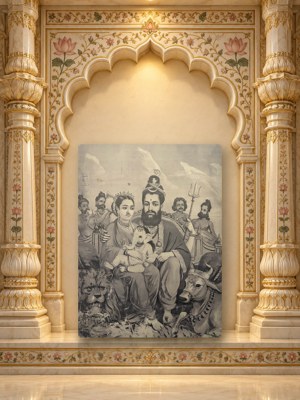
Bhagwan Shiva Ji
AB / MYTH
Bhagwan Shiva Ji, the Mahadev, the Lord of Lords, sits upon his snow-white mountain Kailasa with the trident (trishula) at his side, and beside him Mata Parvati Ji, the Mother of the worlds, the Shakti by whose grace creation moves. On his lap sits their beloved son, Shri Ganesha Ji, the elephant-headed, to whom every prayer is first offered. At their feet lie the lion that bears the Mother as Durga and Nandi Ji, the faithful bull who guards the Lord's door. We bow to the whole divine family: this is the home in which the gods keep house, and the oldest picture of grace in Hindu devotion.
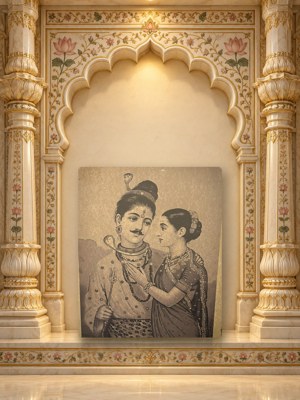
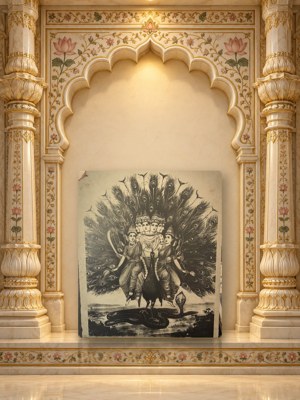
Shri Kartikeya Ji
AB / MYTH
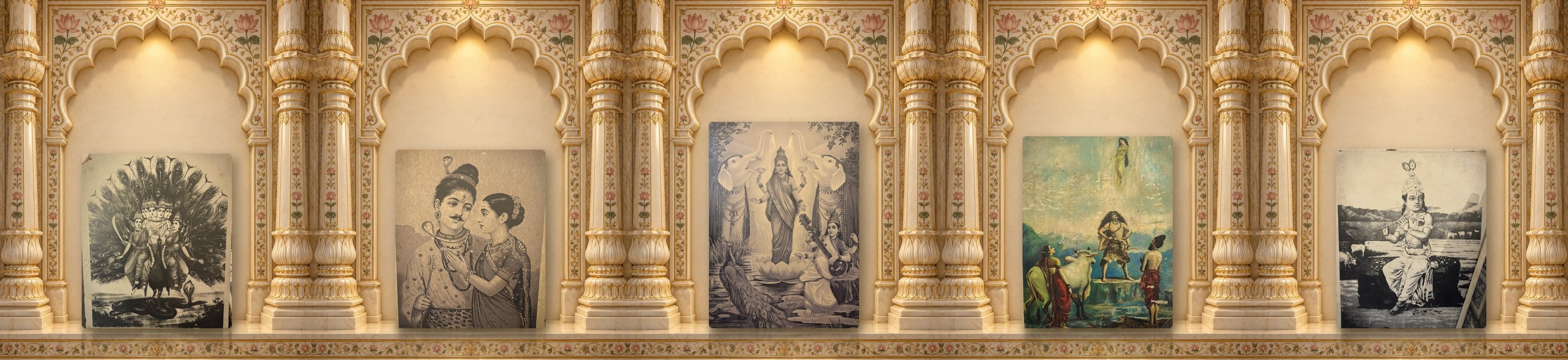
Shri Kartikeya Ji, called Murugan and Subramanya in the south and Skanda across Bharat, is the radiant son of Bhagwan Shiva and Mata Parvati, the Senapati who led the armies of the devas and brought down the demon Tarakasura. His six faces, Shanmukha, watch over every direction at once, and his vahana, the peacock, opens its tail behind him like a halo of living jewels. The cobra beneath is the serpent the peacock is said to conquer: knowledge overcoming poison, light overcoming fear. Vetri Vel, Vel Vel!
Shri Krishna Ji
AB / MYTH
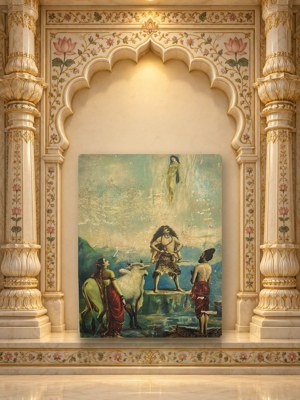
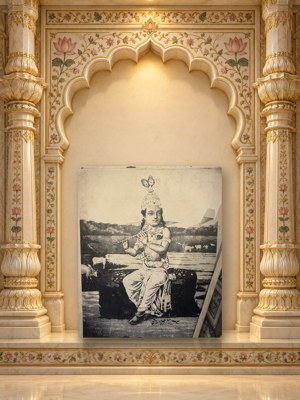
A figure stands upon a plinth between a cow and two devotees, above the water, in turquoise, rose and ochre. The cow is Gau Mata, sacred in every Hindu home and beloved companion of Shri Krishna the herdsman, and the river is the water of life that every tirtha honours. This is a pastoral scene in the devotional tradition the Ravi Varma Press carried into countless households, and one of the very few stones that carries colour. The house describes what the stone shows and does not name a figure it cannot evidence.
Shri Dattatreya Ji
AB / MYTH
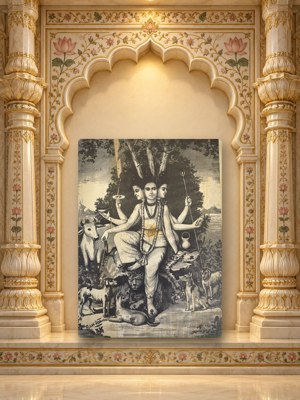
Shri Dattatreya Ji holds Brahma, Vishnu and Mahesh in one divine body: three heads, six arms, the water pot (kamandalu) and the trident in his hands. The cow beside him is Gau Mata, the Earth and Kamadhenu who grants every wish, and the four dogs are the four Vedas, faithful to their Lord. He is the Adi Guru, the teacher who learnt wisdom from all of creation, and he is worshipped with deep devotion in Maharashtra, Karnataka and Gujarat. Avadhuta Chintana, Shri Gurudev Datta.
Shri Hanuman Ji
AB / MYTH
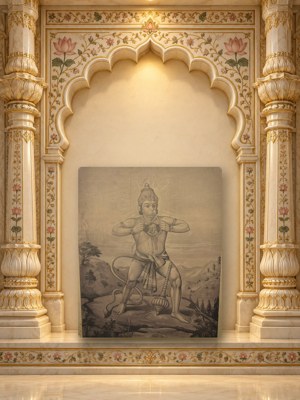
Shri Hanuman Ji, Bajrangbali, son of the wind god Vayu and the greatest devotee of Shri Rama, stands in his mighty stance with his hands to his heart and the mace (gada) at his side. In the Ramayana tradition this is the gesture of the moment he opened his chest to show Shri Rama and Mata Sita living within: bhakti, devotion without a shadow of reserve. He is the remover of fear and the giver of strength and courage. Jai Shri Ram, Jai Hanuman.
Jatayu Ji
AB / MYTH
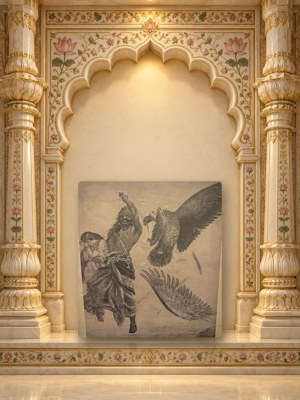
A great eagle strikes at an armed figure whose arm is raised, while a woman is borne at his side. In the traditional reading this is the Aranya Kanda of the Ramayana, where the noble vulture-king Jatayu Ji gave his life to free Mata Sita from Ravana and was blessed by Shri Rama himself, who performed his last rites as a son would. A story of courage and dharma that every Indian child knows. The house describes what the stone shows and notes this as the traditional reading of the composition.
Shri Ganesha Ji
AB / MYTH
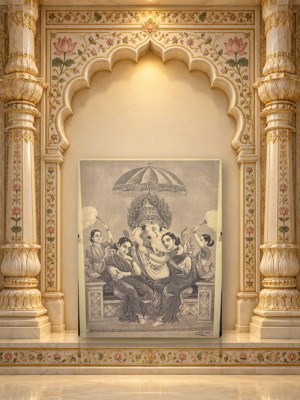
Shri Ganesha Ji, Ganapati Bappa, Vighnaharta, the remover of all obstacles and the Lord of beginnings, sits enthroned beneath the great umbrella (chhatra) of sovereignty, with devotees on both sides raising chowries and instruments in his praise. He is invoked before every undertaking in Hindu life, a new home, a marriage, a journey, a ledger, and no worship begins without him. Om Shri Ganeshaya Namah. Ganapati Bappa Morya.
Maa Lakshmi Ji
AB / MYTH
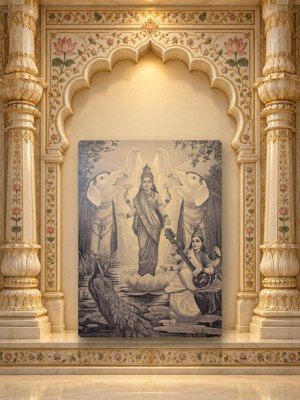
Maa Lakshmi Ji, the Goddess of wealth, fortune and grace, stands upon an open lotus while two white elephants lift their trunks and pour sacred water over her: the Gaja Lakshmi, worshipped on Diwali night. Beside her sits Maa Saraswati Ji with her veena and her string of beads, the Goddess of wisdom, music and speech, and the peacock turns his tail to the water. Prosperity and learning together, the blessing that Hindu households have hung upon their walls for more than a century. Om Shri Mahalakshmyai Namah.
Scenes from the epics and the Puranas
AB / TRADITION
The Ravi Varma Press printed the gods and goddesses of the Puranas and the scenes of the Ramayana and the Mahabharata for ordinary homes, and this stone belongs to that tradition of devotional and epic picture-making. The house describes what the stone shows and does not name a figure it cannot evidence.
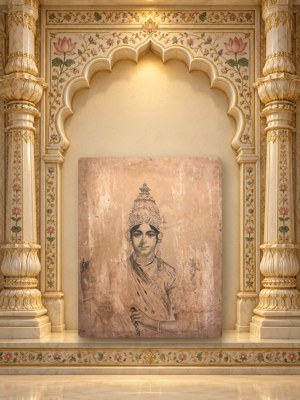 The crowned woman, drawn in fine stippleINR 35,00,000
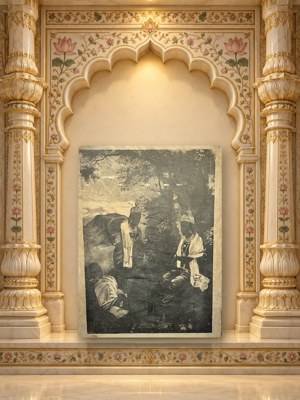 A night scene beneath the treesINR 35,00,000
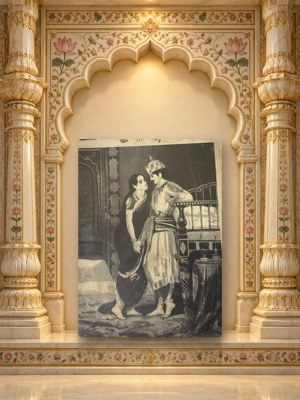 A couple in an interiorINR 45,00,000
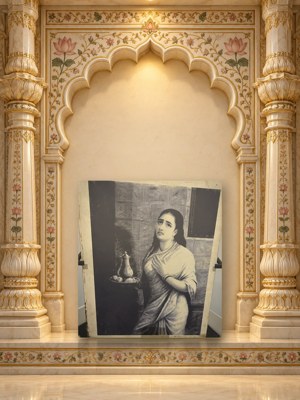 A woman by a water jug, lost in thoughtINR 45,00,000
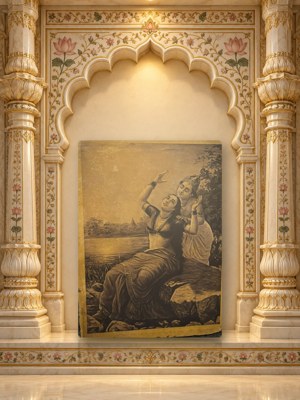 A golden stone: a woman gazing at the skyINR 45,00,000
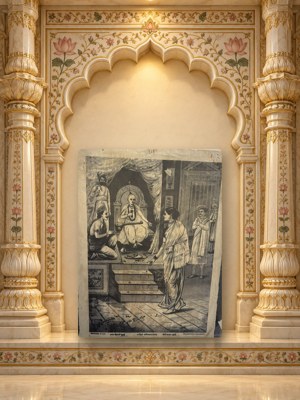 A woman before the seated sageINR 35,00,000
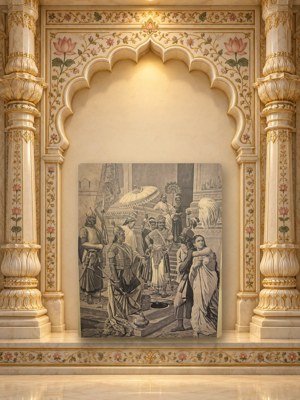 A royal court beneath a parasolINR 45,00,000
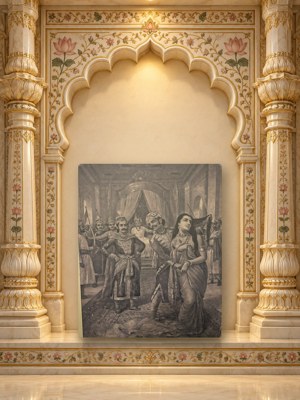 A king and queen entering the hallINR 35,00,000
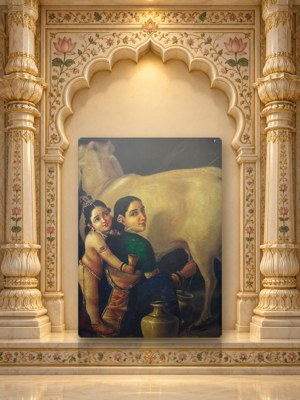 Two women and a cow: a framed colour workINR on enquiry
For researchers and historians
AB / DATA
Every stone has an open record: its reference, subject, tradition, condition, marks, photographs and the people who keep its written record. Download the whole set as JSON or CSV, or read the same facts in plain text. To cite: Arts Bespoke, Ravi Varma Press lithographic stones: fact sheets, artsbespoke.com/stones.json, accessed 21 October 2026. The press itself: founded 1894 in Bombay by Raja Ravi Varma, moved to Malavli near Lonavala in 1899, transferred to Fritz Schleicher in 1901; the full history.
Questions
AB / GODS
Which Hindu gods are shown in the Ravi Varma Press stones?
Shiva and Parvati, Ganesha, Kartikeya (Murugan), Dattatreya, Krishna, Hanuman, Lakshmi and Saraswati, and scenes from the Ramayana, drawn on lithographic stones in the Ravi Varma Press tradition.
What is a lithographic stone?
The flat limestone surface on which a picture was drawn in greasy crayon and from which every print was pulled. It is the original matrix of a lithograph.
Can a stone be bought?
Yes, by private enquiry. Call Mr. Shyam Babu Naidu, Director, on +91 70212 36700. Each stone has a fact sheet and a written record kept by Mr. Arnav Agarwal, and objects of this age fall under the Antiquities and Art Treasures Act 1972.