
Glossary
The words,
explained.
36 terms a collector meets when buying, selling or valuing art, in plain language.
Attribution and signature
AB / TERMS
- Signed
- The artist's name appears on the work in the artist's own hand. A signature is evidence and not proof, and it is judged together with the style, the materials and the history of the work.
- Dated
- A date appears on the work. It may record when the work was begun, finished or signed, and these are not always the same.
- Inscribed
- The work carries writing that is not the artist's signature, such as a title, a dedication or a note. The writing may be in the artist's hand or in another's, and a careful description says which.
- Attributed to
- In the trade this generally means the work is thought to be by the named artist, with less certainty than an unqualified attribution. Houses define the phrase in their conditions of sale, so ask for the definition in writing.
- Studio of
- Generally means made in the artist's studio, possibly under the artist's supervision, but not by the artist's own hand.
- Circle of
- Generally means by an artist closely associated with the named artist, in the same period and manner.
- After
- Generally means a copy of a known work by the named artist, made later and by another hand.
- Catalogue raisonné
- A comprehensive published list of an artist's known works, usually compiled by a scholar or an estate. Inclusion is strong supporting evidence for a work. Not every artist has one.
Provenance and records
AB / TERMS
- Provenance
- The recorded history of a work's ownership from the artist to the present. An unbroken, documented chain is the strongest support for a work's authenticity and value.
- Exhibition history
- A record of the exhibitions in which a work has been shown. Documented showings are part of a work's provenance and can support its date and attribution.
- Literature
- In a catalogue entry, the books, catalogues and articles in which a work has been published or discussed. Published references help to establish a work's identity.
- Certificate of authenticity
- A document in which a seller or an authority states that a work is by the named artist. Its worth rests on who signs it and on the evidence they relied on. It supports a work but does not replace the work's history.
- Condition report
- A written description of the state of a work, noting damage, restoration and wear, usually with photographs. Ask for one before you buy.
- Recto and verso
- The front of a work and its back. The back of a painting often carries labels, stamps and inscriptions that help to trace its history.
- Inventory number
- A unique reference given to a work by the house that holds it, kept for the life of the work so that any record can be matched to the object.
Condition and conservation
AB / TERMS
- Craquelure
- A network of fine cracks in the paint or varnish of a painting, caused by ageing. It is common on older works and is not in itself a fault, but its extent should be reported.
- Foxing
- Brownish spots on paper, caused by mould or by impurities in the paper. It is common on older works on paper.
- Relining
- Attaching a new canvas to the back of an old canvas to support it. It is a major intervention and should always be disclosed.
- Inpainting
- Restoration of lost paint with matching colour, kept to the area of the loss. Its extent is part of a work's condition and should be disclosed.
- Conservation framing
- Framing with materials and methods chosen to protect a work from damage and to be reversible, such as mounts of neutral, non acidic card and protective glazing.
Media and editions
AB / TERMS
- Oleograph
- A colour print made by chromolithography with oil based inks, often given a canvas texture and varnish so that it resembles an oil painting. It is a reproduction process and not a painting.
- Serigraph
- A print made by forcing ink through a screen, with a separate screen for each colour. Also called a screen print.
- Lithograph
- A print made from a design drawn on a flat stone or plate, which holds the ink where it has been drawn. The process allows fine tone and many impressions.
- Giclée
- A print made on an inkjet printer, usually on archival paper or canvas. The name is a trade term. Ask whether a giclée is a reproduction or an edition the artist authorised.
- Original print
- A print that the artist made, or oversaw, as an artwork in its own right, as distinct from a reproduction of an existing work.
- Edition number
- A fraction such as 12/50 marks the number of the impression within the total edition. A smaller edition is generally scarcer.
- Artist's proof
- An impression set aside for the artist, outside the numbered edition. It is usually marked A.P.
Market and sale
AB / TERMS
- Hammer price
- The price at which the auctioneer's hammer falls, before any premium or tax is added.
- Estimate
- The range within which an auction house expects a work to sell, published before the sale. It is a forecast and not a valuation.
- Reserve
- The confidential minimum price below which a seller will not sell at auction.
- Lot
- A single item, or a group of items sold together, in an auction.
- Consignment
- Placing a work with a dealer or auction house to be sold on the owner's behalf, usually for a commission, with title remaining with the owner until it sells.
- Private sale
- A sale arranged directly between seller and buyer, usually through a dealer, and not in public. The terms and the result are not published.
- Deaccession
- The permanent removal of a work from a museum's collection, usually in order to sell it.
- Insurance valuation
- A written figure for the cost of replacing a work, used to set insurance cover. It may differ from market value and from a quick sale figure.
These are the meanings in general trade use. Auction houses and dealers publish their own definitions in their conditions of sale. Where a term matters to a purchase, ask for the seller's definition in writing.
Enquiries
Begin with a conversation
A term that is not here? Write and the desk will explain it.
Write to Client AdvisorySpeak to the house
Works from the house
AB / WORKS
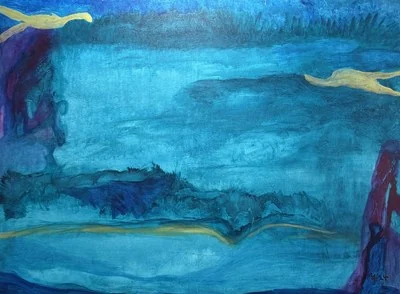
Abstract
A turquoise river and two gold forms
Prakash Bal Joshi. A wide landscape of water and sky worked almost entirely in turquoise, from pale aquamarine to deep ultramarine.
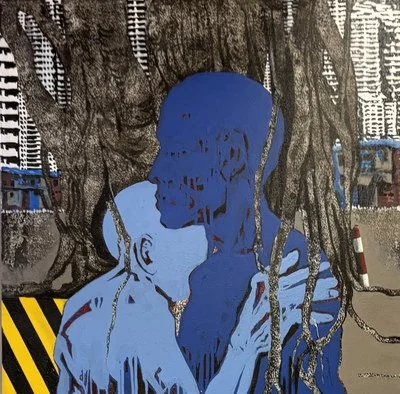
Figures & portraits
Embrace beneath the banyan
Sanjeev Sonpimpare. Two figures, one in deep ultramarine and one in pale cornflower, hold each other in the foreground, their forms cut from flat colour with scratches of red showing through.
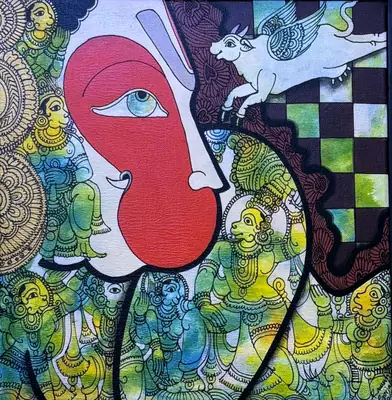
Devotional & narrative
Vermilion face with Kamadhenu
Ramesh Gorjala. A large vermilion half face in profile, with a single green eye, anchors this square canvas.
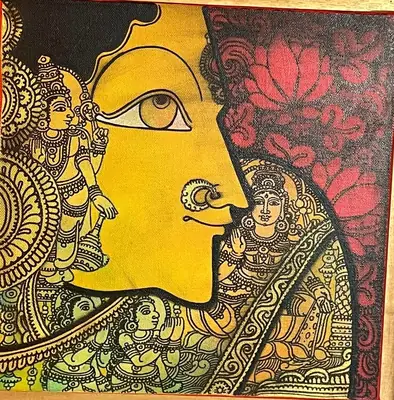
Devotional & narrative
Lakshmi on the lotus, saffron profile
Ramesh Gorjala. A saffron face in profile, a gold ring at the nostril, sets the key of the canvas.
All works Abstract Figures Devotional Landscape Ravi Varma Press stones