
01
A named person answers
Every work, every valuation and every sale has a named person behind it, with a direct line. The heads of the house are listed with their telephone numbers.
The heads of the houseStandards
An art house is trusted for what it declines to say as much as for what it says. These are the standards it keeps, and where to see each one at work.
01
Every work, every valuation and every sale has a named person behind it, with a direct line. The heads of the house are listed with their telephone numbers.
The heads of the house02
Every work is catalogued the day it arrives and given an inventory number that stays with it for life. Every document the work generates carries the same number.
Works available03
A written invoice, a certificate of authenticity, a condition report and the recorded ownership history, all under one house reference.
What provenance means04
An attribution is described exactly as strongly as the evidence supports. Where a field is not yet established the house prints a rule and not a plausible figure, and no work is invoiced until its record is complete.
How attribution is worded05
Where the house offers a work by one of its own officers or advisers, it says so plainly on the work and on that person's page. A collector is always told.
An example06
The house deals in modern and contemporary Indian art. It does not deal in antiquities, which are governed by the Antiquities and Art Treasures Act 1972.
The guide to the rules07
Where a price is printed beside a work it is the whole price. Every other work is priced on request, in writing, before any commitment.
How buying works08
Correspondence is private to its addressee. The site counts visits only if the visitor agrees, and sells nothing about anyone.
How your details are used09
A valuation sets the comparable public auction results beside the figure so that the reasoning can be checked, and the guides list the sources they rely on.
The valuation walkAB / FAQ
Exactly as strongly as the evidence supports. The wording is chosen to match what the ownership history, the signature, the materials and the condition of the work actually show, and no stronger.
The house prints a rule where a fact is not established, and does not fill the gap with a plausible figure. No work is invoiced until its record is complete.
Yes, in some cases. Where it does, it states so plainly on the work and on that person's page, so that a collector is always told.
No. An object more than a hundred years old is an antiquity under the Antiquities and Art Treasures Act 1972, with its own registration and export rules. The house deals in modern and contemporary Indian art.
Enquiries
Hold the house to these standards. If something falls short, write and say so.
Write to Client AdvisorySpeak to the house
AB / WORKS
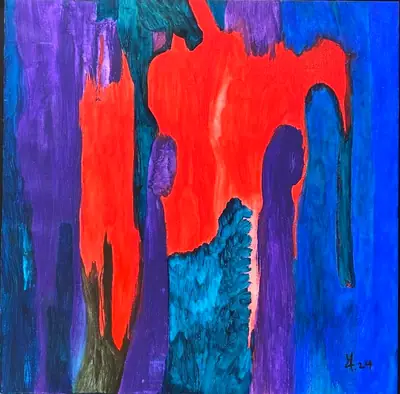
Abstract
Prakash Bal Joshi. A square field worked in ultramarine, violet and teal, with a vermilion form rising through the centre and two dark verticals standing before it.
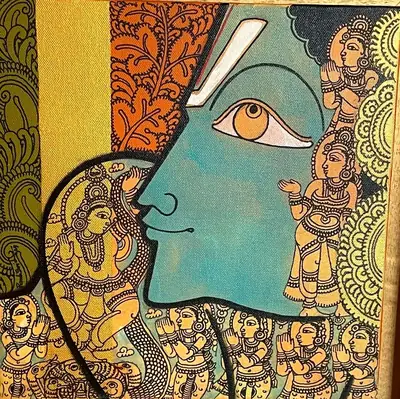
Devotional & narrative
Ramesh Gorjala. A turquoise face in profile, the tilak white against it, looks quietly out of the canvas.
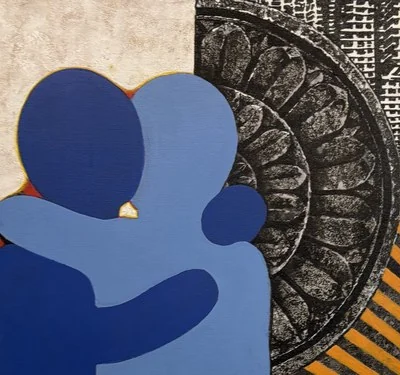
Abstract
Sanjeev Sonpimpare. Two rounded figures, one in deep ultramarine and one in pale cornflower blue, hold each other in an embrace; a smaller dark-blue form nestles against the pale figure's sh.
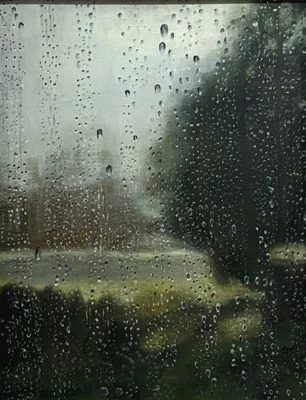
Landscape, nature & trees
Swati. A view through a rain-covered window: a misty park in grey-green, dark trees massing at the right, and a pale path running across the middle distance with a single small.
All works Abstract Figures Devotional Landscape Ravi Varma Press stones